

AIS Field Validates AI-Powered NDT Data Analysis Models in Industrial Refinery Environment
At AIS Field, we believe that the future of non-destructive testing (NDT) data analysis and robotic operations is already being shaped by machine learning and artificial intelligence (AI). Leveraging our extensive labeled NDT databases, built upon our foundation as a spin-off from the advanced inspection company Integrity NDT (integrityndt.com), we are actively engaged in research and development projects focused on integrating AI into NDT and inspection robotics.
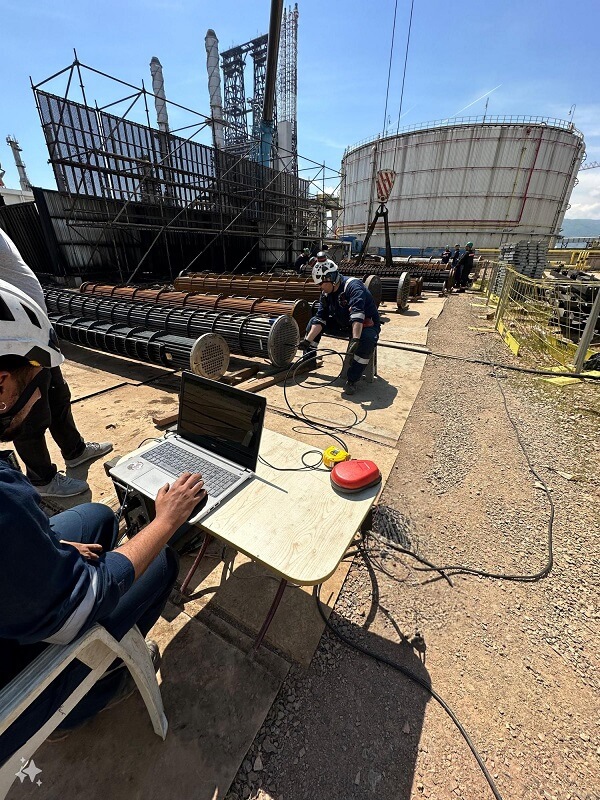
Last week marked a significant milestone for our team as we successfully demonstrated and validated our first AI models in a real-world industrial refinery environment. As part of an ongoing heat exchanger inspection project, we deployed our models on-site to evaluate their performance under real operating conditions.
Over the past year, we have been developing a machine learning–based NDT digital assistant, utilizing over a decade of inspection data collected from industrial facilities around the world. Through extensive research and experimentation, we designed and benchmarked various deep learning architectures, including RNN, LSTM and GRU neural networks, to determine the most effective approaches for heat exchanger eddy current NDT data interpretation.
Our recent validation study focused on eddy current tube inspections of two heat exchangers during a refinery shutdown, both non-ferrous (ASTM B111 UNS C71500 and UNS S32100). Following the data collection phase, we compared the accuracy and speed of analysis and reporting between a human operator and our AI model. The results were outstanding. Our digital assistant, named “AIS X,” accelerated the analysis and reporting process by more than 100%, while maintaining 99% accuracy in defect detection and characterization. All findings were cross-verified with videoscope confirmation.
Encouraged by these results, our team is now working to integrate AI-driven digital assistants into both our robotic platforms and conventional NDT operations, aiming to minimize human error and maximize reliability and efficiency. We have also started exploring potential commercialization pathways for this technology.
In parallel, we are documenting our approach in a scientific paper titled “Development and Comparison of RNN, LSTM, and GRU Neural Network Models for Automated Eddy Current Inspection of Heat Exchanger Tubes Using Real-World Industrial Data,” which will be presented at the BINDT 2024 Conference.
For further insights, explore our latest post on machine learning in NDT: https://aisfield.com/machine-learning-in-non-destructive-testing/
Stay tuned for more updates and innovations from the field!